CAREC Business Forum 2026
Background and Introduction
Since 2001, the Central Asia Regional Economic Cooperation (CAREC) Program has mobilized about $57.9 billion to enhance regional transport connectivity, energy security, and trade facilitation. Although more than 90% of this investment has gone toward the transport and energy sectors, funding for new and cross-cutting sectors is steadily increasing. CAREC investments have played a key role in building, upgrading, and modernizing thousands of kilometers of road and railway networks and transport hubs; expanding energy production and grid connections; simplifying customs procedures; implementing single-window systems; and providing upstream knowledge and capacity support to strengthen regional cooperation and integration (RCI) among CAREC member countries. Despite these achievements, significant infrastructure and financing gaps still exist in the region, especially in traditional sectors like green energy and smart transport and logistics, as well as in emerging sectors such as digital transformation and critical minerals.
CAREC region has significant untapped renewable energy potential, with complementary wind, solar, and hydropower resources that can provide both cheaper generation and system flexibility, while its 4-hour time span creates opportunities for cross-border power trade and system optimization. Beyond energy benefits, renewable energy projects can also contribute to environmental protection, prevent desertification, and their cross-border impacts. Realizing this potential at scale requires stronger regional integration, including enhanced cross-border interconnectivity, coordinated approaches to system balancing, and improved data transparency. As renewable energy expands, these elements will be critical to ensuring reliability, reducing system costs, and enabling efficient use of regional resources. Achieving this will also depend on the right policy actions and strengthened knowledge sharing among policymakers and regulators to align frameworks and support implementation. Advancing practical balancing mechanisms, strengthening transmission networks, and improving data sharing frameworks will be key to unlocking investment, supporting energy security, and accelerating the clean energy transition.
Modernizing CAREC transport corridors through the deployment of smart and digital technologies presents a significant opportunity to enhance regional connectivity, streamline trade flows, and strengthen supply chain resilience. Strategic investment in cross-border connectivity, supported by green and digital transport systems, integrated freight platforms and intelligent logistics solutions, can substantially improve efficiency and transparency along key CAREC corridors. Similarly, the adoption of smart border crossing solutions, including paperless trade and digital documentation, will facilitate smoother border processes and enable seamless movement of goods across the region.
Critical Minerals are central to the global clean energy transition and are increasingly at the forefront of international innovation and industrial policy. CAREC countries possess significant deposits of copper, lithium, rare earth elements, and other strategic minerals, yet the region has not fully transitioned from raw-material extraction to higher-value downstream processing and industrialization. Currently, approximately 85% of mining projects in Central Asia are limited to extraction, with less than 1% of regional trade involving refined or advanced products. To move up the value addition ladder, CAREC countries will need to adopt a comprehensive approach that strengthens geological research, develops specialized human capital, enhances regional and international cooperation to mobilize finance and technology, and upgrades industrial, energy and logistics infrastructure to support more integrated and competitive value chains.
Proactive engagement with the private sector will be essential for mobilizing resources to close the increasing financing and capacity gaps and utilize the latest technologies and innovation. CAREC countries will need to establish a clear and predictable public–private partnership (PPP) framework and reform state owned enterprises (SOEs) to promote private investment and support long-term regional growth. While public funding has traditionally supported infrastructure projects, the scale of investment required for the green energy transition, the modernization of transport corridors, and the support of critical minerals-to-manufacturing (CMM) value chains requires technologies and innovation brought by the private sector. Strategic private-sector involvement not only alleviates fiscal pressure on government budgets but also helps enhance value for money in public procurement, while supporting greater innovation, commercial discipline, operational efficiency, and the adoption of international sustainability standards across regional value chains.
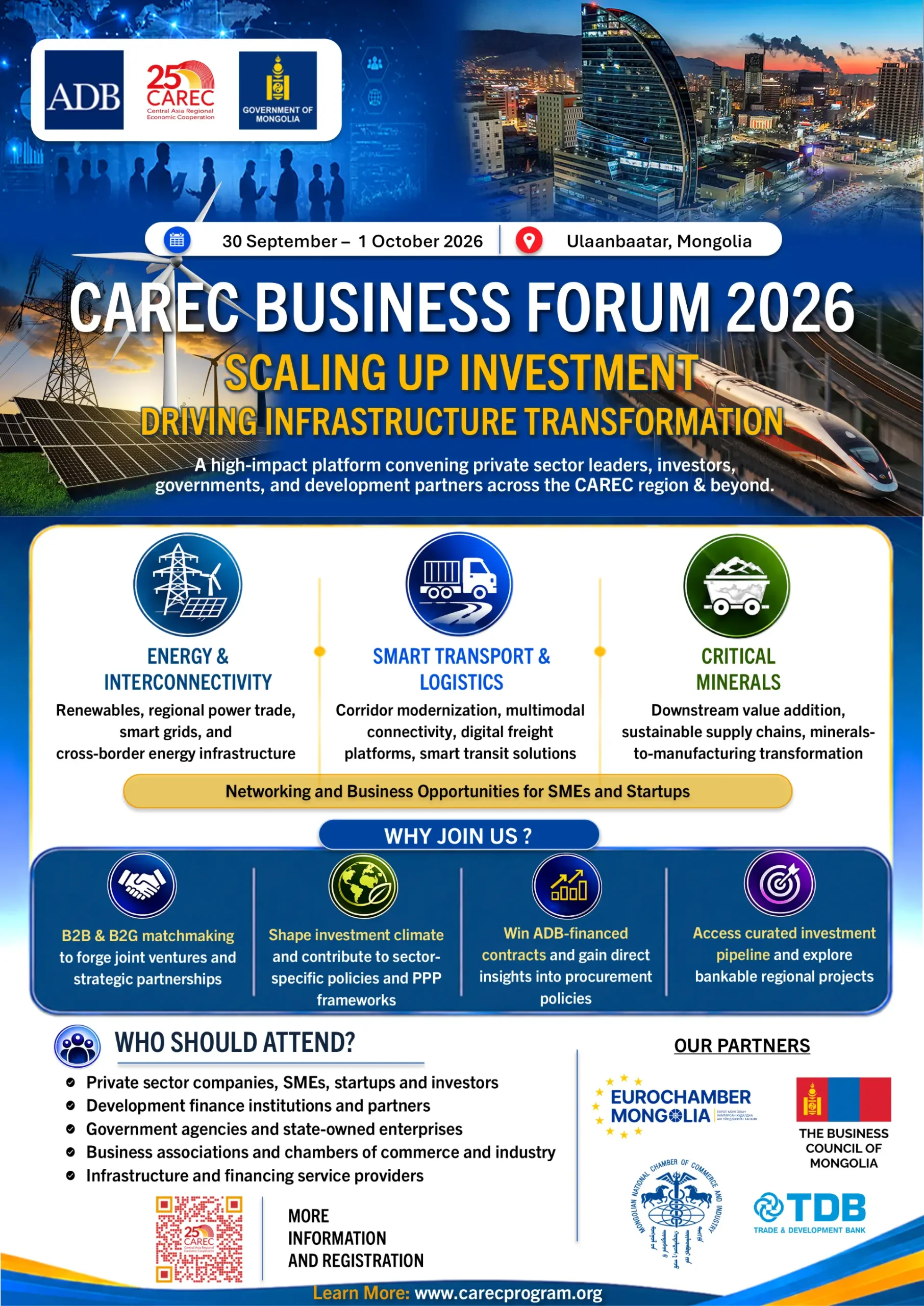
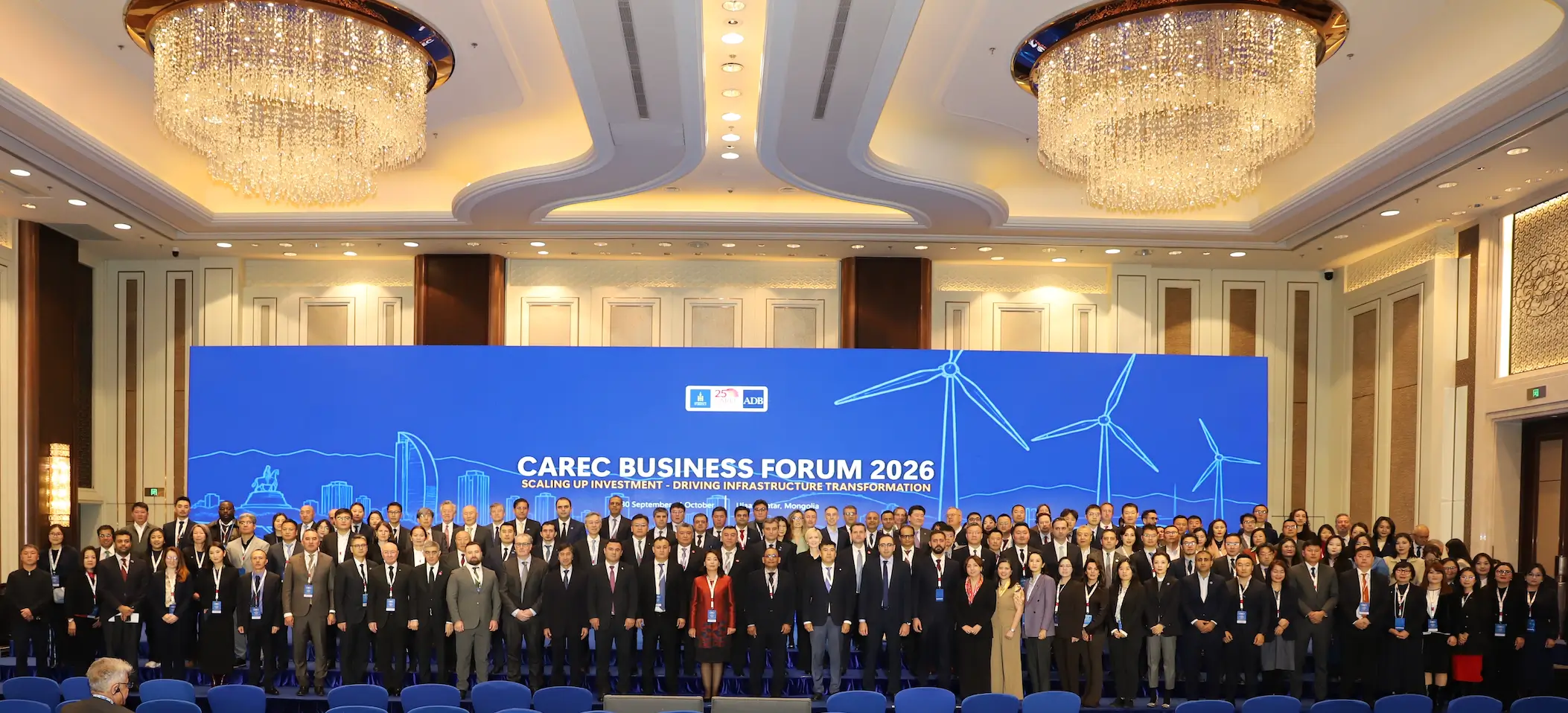
Against this backdrop, the CAREC Business Forum (CBF) is scheduled for 30 September – 1 October 2026 in Ulaanbaatar, Mongolia. The forum is envisioned as a high-impact strategic platform convening approximately 250 participants from the private sector, regional governments, business associations, investors, and development partners. Held in conjunction with the 25th CAREC Ministerial Conference (MC), the forum is organized around three thematic subforums targeting core and emerging sectors to unlock investment opportunities and identify bottlenecks hindering private sector-led infrastructure development.
Objectives
The forum aspires to:
- Showcase investment and business opportunities across the CAREC region, especially in green energy, smart transport and logistics, and critical minerals.
- Facilitate public-private-partnership (PPP) investment into bankable, regionally significant projects.
- Foster dialogue and collaboration among private sector, governments and development partners for advancing regional cooperation and integration.
- Enhance understanding of ADB’s updated procurement policies and frameworks, including recent reforms, compliance requirements, and their application across sovereign operations.
- Build capacity of participants on Merit Point Criteria (MPC) and evaluation processes in ADB procurement opportunities, enabling improved competitiveness and quality of submissions.
- Position Mongolia as a major hub for trade, investment and entrepreneurship in CAREC.
Expected Outcomes
- Public-private collaboration to support investment in regional projects, particularly in forum’s thematic sectors: green energy, smart transport and logistics, critical minerals.
- Access to curated CAREC development partners’ project pipeline, enabling the private sector to explore project-specific investment opportunities.
- Improved knowledge and practical application of ADB procurement policies, including clearer understanding of bidder requirements, evaluation methodologies, and compliance standards.
- Enhanced capacity of firms to prepare responsive and competitive proposals, particularly through effective application of Merit Point Criteria in technical and financial submissions.
- Targeted B2B/B2G matchmaking and partnerships for joint ventures, knowledge exchange and capacity building.
- Informed strategies and operational plans through sector-specific policy recommendations and high-level strategic guidance for each thematic sector.
Focus Sectors
The CBF will engage the private sector from the following key sectors:
- Energy & Interconnectivity – renewables, regional power trade, smart grids, critical minerals;
- Smart Transport & Logistics – corridor development, multimodal integration, digital and green transport solutions; and
- Critical Minerals – downstream value addition, integrated and sustainable value chains.
Click on the flyer to register.